


Experteze NAPARI PLUGIN
Project Team Portal
The purpose of this project is to develop a Napari plugin and AI/ML deep learning algorithm for imaging, visualization, pattern detection,
forecast modeling, malignancy prediction, early detection & treatment of breast cancer tumors.
This portal is intended to be a work-in-progress site to communicate between the members of the team and coordinate our activities.
We welcome subject matter experts to help us in various teams as shown in this website.
We also welcome all developers interested in contributing to the project to join and share their knowledge, expertise or their available bandwidth,
so that, by working together, we can build a tool that will benefit the society.
The participants will have gain open-source development experience and can add this to their resume. Many employers consider participation in
and contribution to open-source projects as a positive trait.
Breast cancer (BC) is one of the most common cancers among women worldwide, representing the majority of new cancer cases and cancer-related deaths according to global statistics, making it a significant public health problem in today’s society. The early diagnosis of BC can improve the prognosis and chance of survival significantly, as it can promote timely clinical treatment to patients. Further accurate classification of benign tumors can prevent patients undergoing unnecessary treatments. Thus, the correct diagnosis of BC and classification of patients into malignant or benign groups is the subject of much research. Because of its unique advantages in critical features detection from complex BC datasets, machine learning (ML) is widely recognized as the methodology of choice in BC pattern classification and forecast modelling.
The dataset proposed for the analysis is a curated dataset of digital breast tomosynthesis images that includes normal, actionable, biopsy-proven benign, and biopsy-proven cancer cases. The dataset contains four components: (1) DICOM images, (2) a spreadsheet indicating which group each case belongs to (3) annotation boxes, and (4) Image paths for patients/studies/views.
Our image download from PACS resulted in an initial collection of 16,802 studies (a radiology breast exam with a DBT on a particular date with a unique StudyInstanceUID DICOM tag) from 13,954 patients (unique MRNs) with at least one of the craniocaudal (CC) and mediolateral oblique (MLO) views available for the left or right breast. Each of the left or right CC and MLO views will be referred as volumes. Each individual two-dimensional slice in a volume will be referred as image. The dates of these studies within our initial collection lie between August 26, 2014 and January 29, 2018.
ANNOTATION DETAILS
Two radiologists (18 years and 25 years of experience) at our institution annotated the studies. A subset of the available studies was considered for annotation such that these studies had either mass or architectural distortion which resulted in a biopsy with a benign or cancer finding. Each volume was annotated by one radiologist. During annotation, radiologists were provided with the corresponding radiology report and applicable pathology reports. Specifically, the radiologists drew a rectangular box enclosing a biopsied tumor in the central slice. All annotations were performed using an in-house computer software.
METHODOLOGY:
The supervised DBT image classification of breast will be performed using Inception_V3 and Inception_ResNet_V2 based. Inception_ResNet_V2 network is the best deep learning architecture so far for diagnosing breast cancers by analyzing DBT images. Therefore, we propose to use Inception_ResNet_V2 to extract features from breast cancer DBT images to perform unsupervised analysis of the images. We also constructed a new autoencoder network to transform the features extracted by Inception_ResNet_V2 to a low dimensional space to do clustering analysis of the images. The experimental results of autoencoder network results in better clustering results than those based on features extracted only by Inception_ResNet_V2 network is to be evaluated using the performance analysis. Inception_ResNet_V2 network based deep transfer learning provides a new means of performing analysis of DBT of breast cancer.
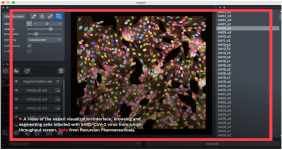
Napari is a fast, interactive, multi-dimensional image viewer for Python. It’s designed for browsing, annotating, and analyzing large multi-dimensional images. It’s built on top of Qt (for the GUI), vispy (for performant GPU-based rendering), and the scientific Python stack (e.g. numpy, scipy). It includes critical viewer features out-of-the-box, such as support for large multi-dimensional data, and layering and annotation. By integrating closely with the Python ecosystem, napari can be easily coupled to leading machine learning and image analysis tools (e.g. scikit-image, scikit-learn, TensorFlow, PyTorch), enabling more user-friendly automated analysis. The result of the breast cancer image classification will be viewed using the Napari Plugin.
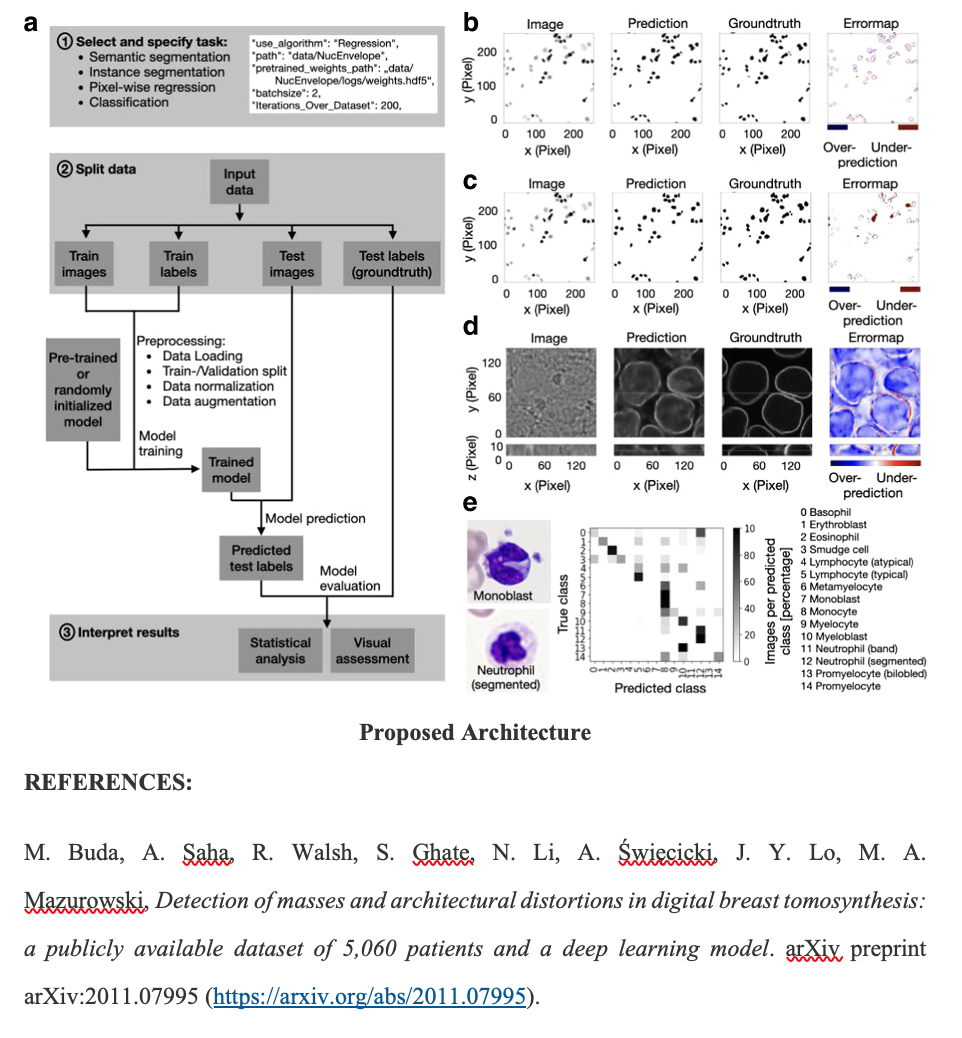
We propose to develop Cutomized Napari Plugin with a deep learning pipeline for four common image processing tasks: semantic segmentation, instance segmentation, pixel-wise regression and classification of breast cancer DBT images. It will in future enables researchers with a basic computational background to apply debugged and benchmarked state-of-the-art deep learning algorithms to their own data with minimal effort. To make the pipeline robust, we have automated and standardized workflows and extensively tested it in different scenarios. Moreover, it allows assessing the uncertainty of predictions. We need to benchmark the customized Napari Plugin ML Pipeline on seven publicly available datasets achieving competitive performance without any parameter tuning. For customization of the pipeline to specific tasks, all code is easily accessible and well documented.
PROJECT DOCUMENTS
Click on image to download documents
-

Please stay tuned
MEETING MINUTES
Click on image to download documents
-
Please stay tuned